Key figures
- Overall size L×W×H (mm)2050×1280×1576
- Feed size (mm)10–50
- Output size (mesh)20–120
- Finished product rateabout 85%
Figures are for the base model. All models in this family are listed below.
Overview
What it is
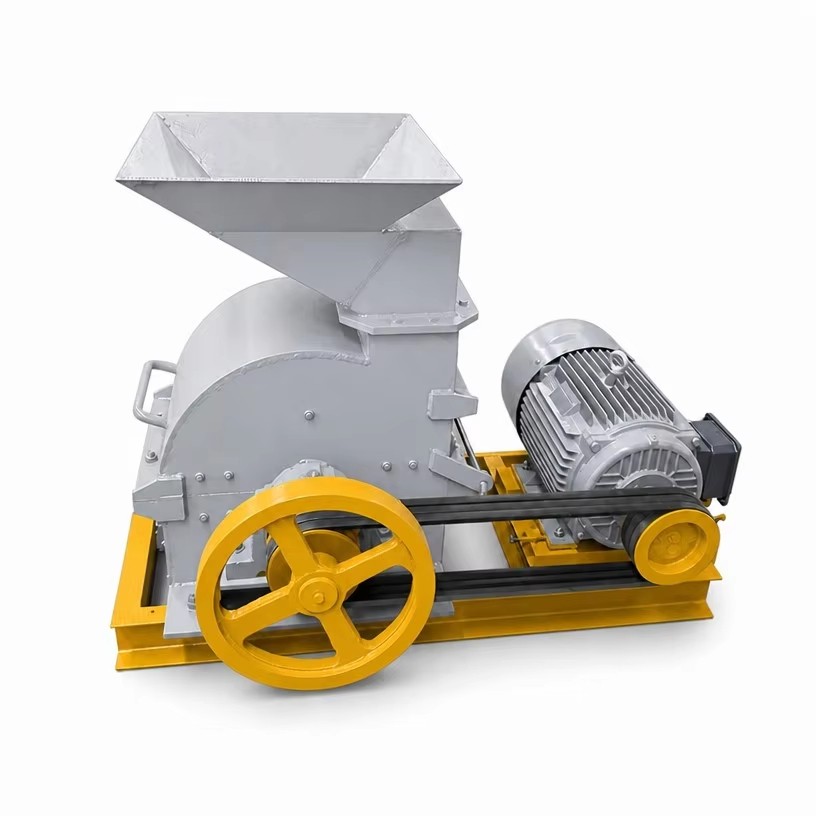
A heavy-duty vertical-shaft impact mill — the 立轴式 sand maker used in crushing and sand-making lines — built in two sizes. It takes run-of-crusher feed and reduces it to a fine product in one pass, so it sits where a plant needs sand or fine material without a mill circuit.
What it accepts
Building materials, mining, metallurgy and chemical industry: limestone, clinker, coal and other ores, provided the compressive strength is not above 140 MPa and the moisture content is not above 15%. Those two limits are the practical ones — a harder rock wears the bars faster, a wetter feed blinds the discharge.
Why it processes a lot
The hammer bars are joined rigidly rather than in the traditional loose arrangement. Working, the rotor's inertia is used to strike the material, which gives both the breakage and the velocity it needs, and that is what lifts throughput for the size of the machine.
Why the wear parts last
The body is a combined structure rather than one integral casting, so it takes hard impact without cracking. Each hammer bar can be turned and used on both faces, and the toothed joint between rotor and bar lets the bar be moved outward as it wears, so more of the metal is used before it is scrapped. That is where the lower running cost comes from.
Energy, dust and noise
The frame is compact, light and small for its capacity, and carries an internal dust-proof device with good sealing. Fine material stays inside the casing, so there is little dust around the unit and the working noise is low — which matters when it stands in a workshop rather than in an open pit.
The two sizes
The 1000 is not simply a bigger drum. Compared with the 800 it takes coarser feed (80 mm against 50 mm), carries thicker liners (45 mm) in a thicker shell (20 mm), and heavier hammer bars (15 kg against 8 kg). That is what allows 7–10 t/h on 75 kW where the 800 does 5–7 t/h on 45 kW, and it is why the 1000 is the one to specify for a harder or coarser feed rather than for a slightly higher tonnage of the same material.
Lubrication and drive
The 800 runs a thin-oil lubrication station, the 1000 a grease pump. Both start on a variable-frequency drive; the cabinet is rated 75 kW for the 800 and 110 kW for the 1000, above the motor rating so that the start and the run are not limited by the cabinet.
Notes
Output is quoted in mesh: 20–120 mesh is roughly 0.85 down to 0.125 mm, and 16–180 mesh roughly 1.0 down to 0.08 mm. Finished product rate of about 85% and 80% is the proportion falling inside the target range, so the balance is returned or re-crushed. The main shaft size is given for the 800 only. Technical parameters are subject to change without further notice.
The two sizes

All models
| Parameter | 800 | 1000 |
|---|---|---|
| Overall size L×W×H (mm) | 2050×1280×1576 | 2380×1380×2125 |
| Feed size (mm) | 10–50 | 10–80 |
| Output size (mesh) | 20–120 | 16–180 |
| Finished product rate | about 85% | about 80% |
| Capacity (t/h) | 5–7 | 7–10 |
| Power (kW) | 45 | 75 |
| Starting method | Variable-frequency start | Variable-frequency start |
| VFD cabinet (kW) | 75 | 110 |
| Lubrication | 1 set, thin-oil station | 1 set, grease pump |
| Feed hopper | 1, dual-feed | 1, dual-feed |
| Liner plates | 60 pcs, 7.5 kg each, high-manganese steel | 72 pcs, 13 kg each, high-manganese steel |
| Hammer bars | 24 pcs, 8 kg each, high-chrome alloy with tungsten steel rod | 24 pcs, 15 kg each, high-chrome alloy with tungsten steel rod |
| Main shaft | Φ140 | — |
| Liner thickness | — | 45 mm |
| Shell thickness | 12 mm | 20 mm |
Swipe the table sideways to see every column →