
Key figures
- Processing Capacity (t/h)1–3
- Boundary Dimension (mm)1650×1515×1300
- Rotor Speed (r/min)480
- Feed Size (mm)≤6
Figures are for the base model. All models in this family are listed below.
Overview
What it is
The STL vertical centrifugal concentrator is an intensified-gravity gold separator built on the centrifugal principle. In a high-intensity gravity field the weight difference between particles of different specific gravity is amplified many times over, which makes heavy–light separation far easier than it is in the natural gravity field. A fluidised-water and interference-sedimentation system keeps the material bed in a continuously loose state, so heavy particles take the place of light ones in the bed and stay there while light particles leave as tailings. Separation is therefore by specific gravity.
Two versions are built: vertical manual ore discharge (STL40, STL60, STL80) and automatic discharge with vertical shutdown (STL60, STL80, STL100).
Working principle
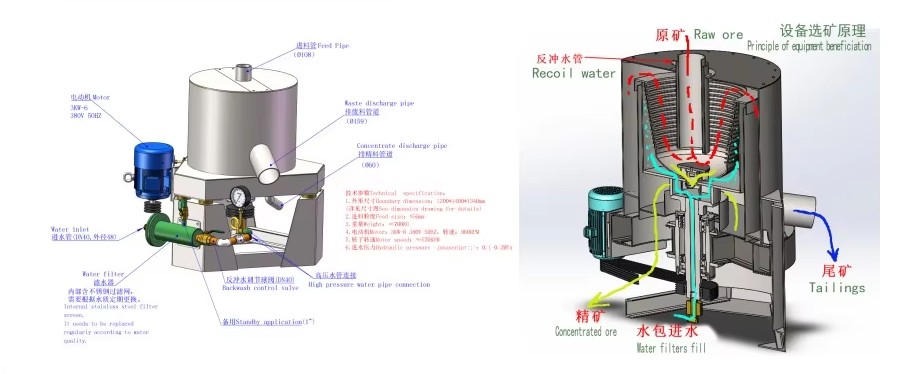
When running, centrifugal acceleration inside the enrichment cone reaches 60 g or more. Pulp enters at the bottom of the cone, is thrown against the inner wall and travels up along it, while water is injected continuously through the water inlet hole to fluidise the bed.
Under the combined action of centrifugal force and recoil water pressure, heavy particles — including free gold — overcome the radial resistance and settle into the concentrate bed by centrifugal and inter-granular sedimentation. Gangue grains cannot overcome the recoil water because their centrifugal force is small, so they are driven out of the cone by the axial flow impulse and the axial component of centrifugal force, and report to tailings.
Feed size and recovery
The feed range is wide — the automatic-discharge model takes 0–6 mm — and the recoverable particle band is wide as well. Taking gold ore as the example: +38 μm is the easiest fraction to recover, 10–38 μm is recoverable, and −10 μm is difficult. In practice most of the free, monomer-dissociated gold falls in the recoverable band, which is why this machine recovers it well.
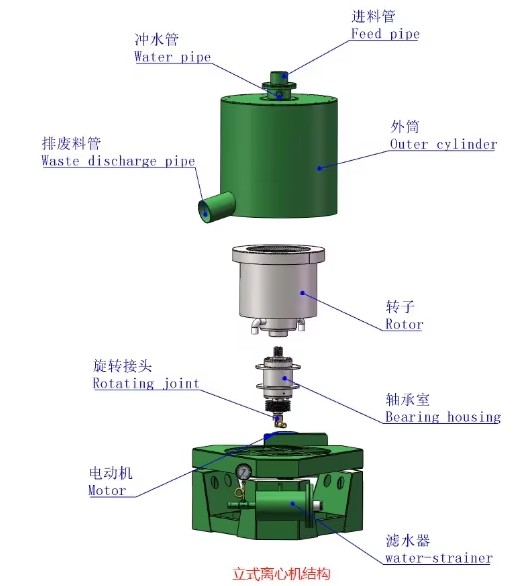
Main assemblies
- Feed pipe and water pipe on top of the outer cylinder.
- Rotor and rotating joint inside the cylinder.
- Bearing housing and motor on the base frame.
- Waste discharge pipe for tailings.
- Water strainer on the supply line — clean it if it blocks.
Structure and separation principle
All models
| Parameter | STL40 (manual) | STL60 (manual) | STL80 (manual) | STL60 (auto) | STL80 (auto) | STL100 (auto) |
|---|---|---|---|---|---|---|
| Processing Capacity (t/h) | 1–3 | 5–15 | 15–25 | 5–15 | 15–25 | 25–40 |
| Boundary Dimension (mm) | 1650×1515×1300 | 2100×1900×1700 | 2750×2600×2150 | 2150×1550×1940 | 2500×1900×2270 | 2870×2180×2630 |
| Rotor Speed (r/min) | 480 | 480 | 420 | 480 | 420 | 360 |
| Feed Size (mm) | ≤6 | ≤6 | ≤6 | ≤6 | ≤6 | ≤6 |
| Water Consumption (m³/h) | 9–15 | 31–35 | 36–50 | 21–35 | 30–50 | 40–70 |
| Feed Concentration | 30% | 30% | 30% | 30% | 30% | 30% |
| Recoil Water Pressure (MPa) | 0.1–0.3 | 0.1–0.3 | 0.1–0.3 | 0.1–0.3 | 0.1–0.3 | 0.1–0.3 |
| Unloading Wash Time (min) | 1–2 | 2–4 | 4–8 | 10 | 10 | 10 |
| Motor Power (kW) | 3 | 7.5 | 11 | 7.5 | 11 | 15 |
| Weight (kg) | 620 | 1170 | 2040 | 2500 | 3800 | 4200 |
Swipe the table sideways to see every column →
Centrifugal concentrator — selection questions
Answers drawn from the published model table and working principle above.
What gold particle size does a centrifugal concentrator recover?
On gold ore, +38 μm is the easiest fraction to recover, 10–38 μm is recoverable, and −10 μm is difficult. Most free, monomer-dissociated gold falls inside the recoverable band, which is why the machine performs well on gravity-recoverable gold. Feed size into the concentrator itself is ≤6 mm.
What throughput range does the STLB series cover?
Six models span 1–3 t/h (STL40) up to 25–40 t/h (STL100 auto). The middle of the range is 5–15 t/h (STL60) and 15–25 t/h (STL80). Rotor speed falls as the cone grows — 480 r/min on STL40 and STL60, 420 r/min on STL80, 360 r/min on STL100 — so capacity is added by cone size, not by overspeeding.
Manual or automatic discharge — which one?
STL40, STL60 and STL80 are built with manual ore discharge; STL60, STL80 and STL100 are also built with automatic discharge and vertical shutdown. Manual models unload in 1–8 minutes depending on cone size; automatic models run a 10-minute unloading wash cycle without stopping the feed train. Choose manual for low tonnage where an operator is present, automatic where the concentrator sits inside a continuous circuit.
Centrifugal concentrator or shaking table — which do I need?
They do different jobs. The STLB concentrator takes feed up to 6 mm at 1–40 t/h and is used to pull a high-grade concentrate out of a large stream. The 6S shaking table takes much finer, narrower feed — 0.2–2 mm on the coarse sand deck, 0.074–0.5 mm on the fine sand deck, 0–0.15 mm on the slime deck — at 0.2–1.5 t/h, and is used for the final cleaning stage. Most gravity circuits run the concentrator first and the table on the concentrate.
How much water and power does it need?
Water consumption runs from 9–15 m³/h on STL40 to 40–70 m³/h on STL100, with recoil water pressure held at 0.1–0.3 MPa. Motor power runs 3 kW on STL40, 7.5 kW on STL60, 11 kW on STL80 and 15 kW on STL100. Feed concentration is held at 30% across the range.
Why does the machine use fluidised water instead of a fixed bed?
Inside the enrichment cone, centrifugal acceleration reaches 60 g or more. Water injected through the inlet hole fluidises the bed so it stays continuously loose: heavy particles — including free gold — overcome the radial resistance and settle into the concentrate bed, while gangue grains, whose centrifugal force is small, cannot overcome the recoil water and are driven out to tailings. Separation is therefore by specific gravity, not by screening.
Related equipment
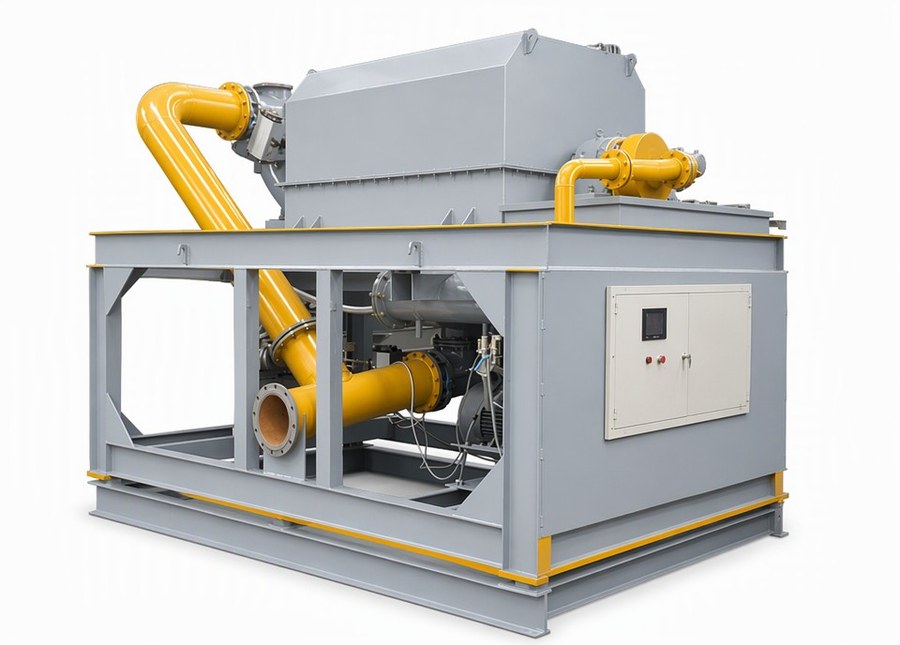 Horizontal Centrifugal Concentrators5 models
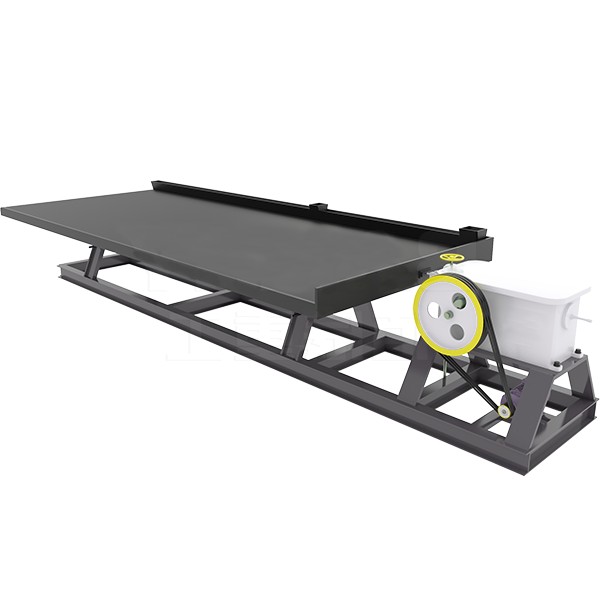 6S Shaking Tables3 models
 Jaw Crushers — PE & PEX Series13 models